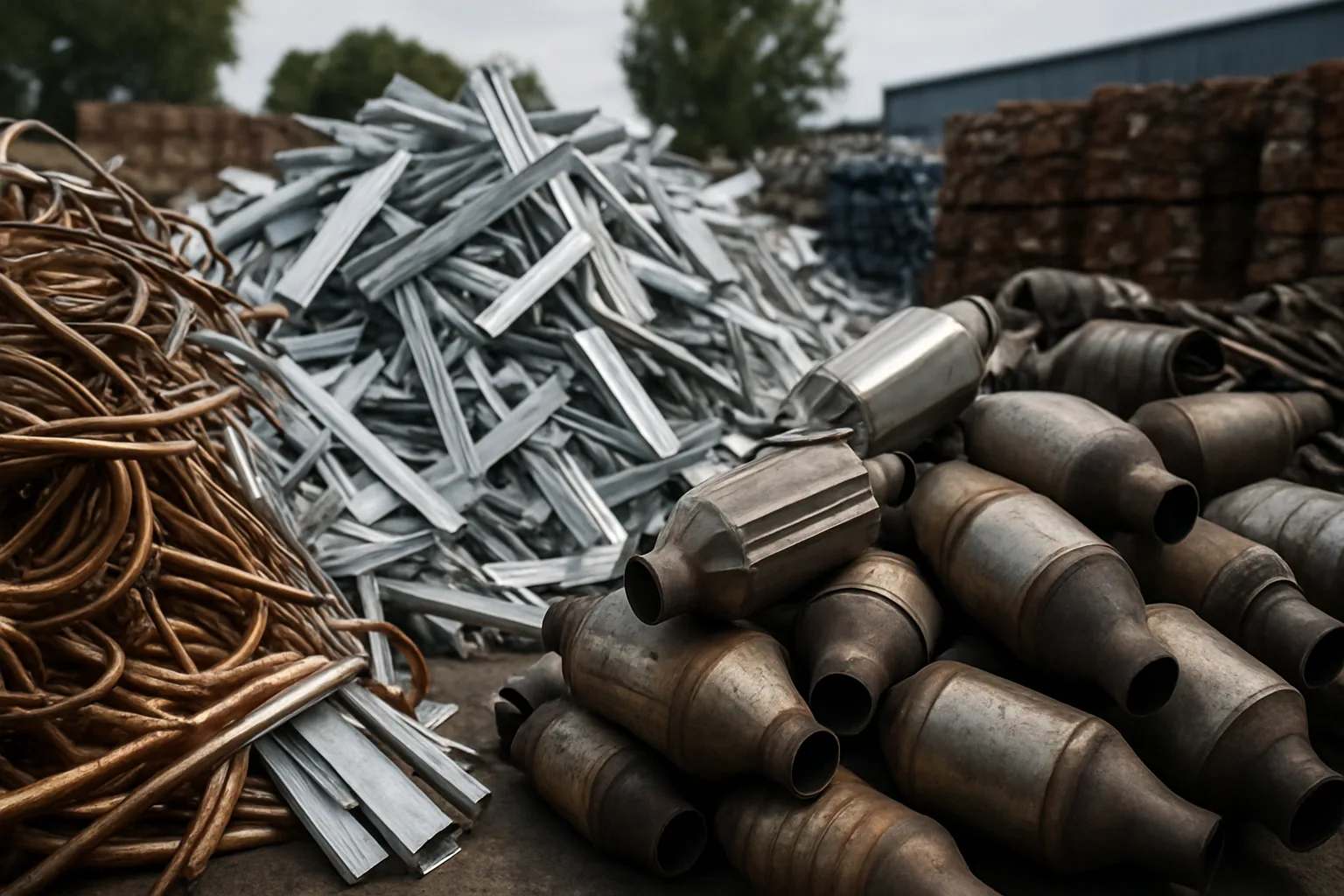
Catalytic converters sitting in your parts pile could be worth serious money — or almost nothing. The difference often comes down to what's inside and who you're selling to.
If you've been trying to figure out the aluminum scrap price today alongside what your cats are worth, you're not alone. Most sellers treat these as separate categories, but smart recyclers price everything together when they're moving a mixed load. This guide breaks down how catalytic converter recycling actually works, why prices swing so dramatically, and how to avoid leaving money on the table when you're selling in Los Angeles.
What's Actually Inside a Catalytic Converter
The value in a catalytic converter has nothing to do with the steel shell. It's about what's inside: platinum group metals, or PGMs. That means platinum, palladium, and rhodium. These three metals are what refiners are actually paying for when they buy your cats.
The ceramic or metalite substrate inside the converter holds trace amounts of these metals. When the converter gets processed, the substrate gets crushed and assayed to determine exact PGM content. That assay result — not a visual guess — is what drives the final payout at serious refiners.
- Platinum: Used across a wide range of converters, especially diesel units
- Palladium: Found heavily in gasoline engine converters
- Rhodium: Present in smaller amounts but historically the highest value per ounce of the three
The aluminum housing or end caps on some converter types do carry scrap value — which is why knowing the aluminum scrap price today matters if you're stripping and sorting before you sell.
Why Catalytic Converter Prices Vary So Much
Two identical-looking cats can have drastically different values. This surprises a lot of sellers the first time they get a quote. Here's why the gap exists.
Vehicle make and model matter enormously. A converter from a late-model Toyota or Honda typically holds more PGM loading than one from a domestic econobox from the same era. Larger displacement engines, luxury marques, and certain foreign nameplates are known to carry higher PGM content. Scrap buyers who specialize in cats use serial numbers and VINs to identify the exact unit — and price accordingly.
Market pricing for PGMs fluctuates daily. Rhodium, for example, has historically seen price swings of thousands of dollars per ounce in short timeframes. That volatility flows directly into what buyers will pay for a given unit today versus last week. This is why a quote you got six months ago means nothing for what you'll receive now. To understand the broader pricing environment, check today's scrap metal prices before you bring anything to a buyer.
Additional factors that affect pricing:
- Whether the converter is intact or cracked (damaged substrates pay less)
- The age and condition of the substrate
- Whether it's an OEM unit or a direct-fit aftermarket replacement
- The buyer's relationship with downstream refiners
- Local supply and demand in your market
How the Recycling Process Works From Your Yard to the Refiner
Most sellers hand off their cats at a local scrap yard or specialty buyer, but understanding the full chain helps you negotiate better. Here's the pipeline from your hands to the final payment.
Step 1 — Identification: A serious buyer identifies every unit by serial number or manufacturer code. Guessing based on visual appearance is the old way — it leaves money on the table or invites underpricing. Platforms and buyers that use VIN lookup and serial tracking give you a more defensible starting point for any negotiation.
Step 2 — Sorting and grading: Converters get sorted by type (foil/metalite versus ceramic substrate, domestic versus foreign). This grading directly affects the per-unit price offered.
Step 3 — Processing: A refiner receives the sorted material, decans the substrate, and processes it through crushing and sampling to determine actual PGM yield. This is called the assay process.
Step 4 — Settlement: Based on the assay results and that day's spot price for platinum, palladium, and rhodium, the refiner settles with the buyer — and the buyer settles with you. This is why the time between drop-off and final payment isn't always immediate for large lots.
Understanding this pipeline matters when you're evaluating offers in Los Angeles. A buyer offering immediate cash is pricing in a discount for taking on the risk and float. A program that pays on assay results gives you the upside if PGM content is strong — but requires you to trust the process and the counterparty.
Best Scrap Metal Prices Los Angeles: What Sellers Need to Know
Los Angeles has a dense recycling infrastructure, but that doesn't automatically mean you're getting competitive rates. With so many Los Angeles scrap metal services operating across the region, the spread between the best and worst offers can be significant — especially on high-value material like cats.
The common mistake sellers make is calling one buyer, getting a number, and accepting it. That's how yards have gotten away with paying below-market rates for decades. If you're looking for the best scrap metal prices Los Angeles has to offer, you need more than one quote — you need competing offers from buyers who know what they're bidding on.
This is exactly where platforms like SMASH change the dynamic. Instead of one phone call and one number, you get documented inventory, vetted buyers, and competitive bids on your actual material. That's better price discovery, not a guarantee — but competition tends to produce better outcomes than a single-buyer conversation with no transparency.
A few practical tips for Los Angeles sellers specifically:
- Document every unit with photos and serial numbers before you sell
- Don't rely on a visual quote — insist on serial-based identification
- Track current PGM spot prices the same way you'd track copper or aluminum
- Understand whether you're getting a street price or a refinery-yield-based price
California has seen increased regulatory attention on catalytic converter sales in recent years, which has affected documentation requirements at many buying locations. Keep records of your inventory — it protects you legally and commercially.
Aluminum Scrap Price Today and Mixed Loads: Pricing the Full Haul
If you're moving catalytic converters, there's a good chance you're also sitting on aluminum, copper, or steel from the same vehicles or dismantling work. The aluminum scrap price today in Los Angeles typically reflects national commodity trends with a regional adjustment for transportation and local demand.
When you're pricing a mixed load, don't let a buyer aggregate everything into a single blended number. Cats, copper, aluminum, and steel should each be priced on their own merits. Letting a buyer blend these into one offer almost always benefits the buyer, not you.
Knowing current rates for each material category is foundational. Find current scrap metal prices near you so you walk into any conversation with real numbers, not assumptions. The difference between an informed seller and an uninformed one is often hundreds of dollars on a single load.
A quick reference for what to track before you sell a mixed load:
- Aluminum scrap price today — varies by grade (cast, extrusion, sheet, painted)
- Copper scrap price — #1 bare bright vs. #2 copper carries a real spread
- Steel scrap price — bulk iron pays less per pound than sorted ferrous grades
- Current PGM spot prices — platinum, palladium, and rhodium independently
To stay current on all of these, read the latest scrap metal market updates before you make a move.
How to Sell Catalytic Converters Online and Get a Fair Price
The ability to sell catalytic converters online has opened up access to buyers outside your local market. This matters because a specialty cat buyer in another state may pay significantly more than a general scrap yard near you — even after factoring in shipping.
The key to selling cats online effectively is documentation. Clear photos of the converter, visible serial numbers, and accurate condition descriptions separate sellers who get strong offers from those who get lowball bids. Buyers bidding without seeing the material need confidence — and photos plus serials give them that.
Find the best price for your scrap on SMASH — the platform handles inventory documentation, buyer vetting, and the auction process so that multiple buyers compete for your material. That's the structural difference between one call to one yard and a transparent bidding environment where buyers know they're competing.
For larger lots or regular volume, establishing relationships with buyers who pay on assay — rather than street price — tends to produce better long-term results. Track your results over time. If you're consistently getting low returns on cats, the problem isn't the material; it's the sales process.
Disclaimer: Scrap metal prices, including platinum group metal values and aluminum scrap prices, fluctuate based on global commodity markets. Always verify current rates before selling. The figures and ranges referenced in this article are general in nature and should not be relied upon as current market prices.
Frequently Asked Questions
Q: What determines the aluminum scrap price today in Los Angeles?
The aluminum scrap price today is driven by global commodity markets, primarily the London Metal Exchange (LME) benchmark, adjusted for local supply and demand in the Los Angeles region. Grade also matters significantly — extrusion aluminum pays differently than cast or painted aluminum. Check a reliable pricing source before you sell to know which grade you have and what it's worth.
Q: Why do two catalytic converters that look the same have different prices?
Appearance doesn't determine value — PGM loading does. Two visually similar converters from different vehicles can have dramatically different platinum, palladium, and rhodium content based on manufacturer specs. Serious buyers identify units by serial number to price them accurately. If a buyer is only looking at the unit visually, that's a red flag.
Q: How do I find the best scrap metal prices in Los Angeles?
Get more than one quote. The best scrap metal prices in Los Angeles — or anywhere in California — come from competitive offers, not from the first number a single buyer gives you. Document your material, know current commodity benchmarks, and use platforms that create real buyer competition rather than relying on a single phone call.
Q: Can I sell catalytic converters online if I'm based in Los Angeles?
Yes. Many specialty cat buyers operate nationally and will accept shipped material. For larger lots, selling catalytic converters online through a competitive platform often produces better price discovery than local-only options. Proper documentation — serial numbers, photos, condition notes — is essential for getting strong online offers.
Q: What should I track besides aluminum scrap prices when selling a mixed load?
Track copper scrap prices (by grade), steel scrap prices, and current PGM spot prices for platinum, palladium, and rhodium. Each material category should be priced and negotiated independently — never let a buyer blend them into a single number without seeing the breakdown. Knowing each rate before you sell protects you from being underpaid on your highest-value materials.
The scrap market rewards sellers who show up prepared. Know your material, document it properly, and don't settle for a single offer when the technology exists to do better. Check today's scrap metal prices and get current rates at scrap-metal-prices.com — it's the fastest way to walk into any buyer conversation with real numbers behind you.
Stay ahead of scrap metal market moves — follow SMASH on LinkedIn for industry updates, pricing insights, and recycling market news.